GEO audit — score your site for AI engines
A Generative Engine Optimization audit measures whether ChatGPT, Claude, Perplexity, Gemini and other AI engines can crawl, understand and cite your pages. crawler4seo runs a full GEO audit locally — no signup, no data upload — and returns a 0–100 score with the exact signals to fix.
What is a GEO audit?
Generative Engine Optimization (GEO) is to AI search what SEO is to Google. A GEO audit scores your site on the signals large language models and AI-powered search engines — ChatGPT, Claude, Perplexity, Gemini, Bing Copilot — use to decide whether to crawl, understand, and cite your content.
Traditional SEO audits check if Google can find your pages. A GEO audit checks if AI engines can find them and extract a citable answer from them. The two overlap (both care about schema, crawlability, speed) but GEO adds signals traditional audits ignore: AI-bot robots.txt rules, llms.txt, JavaScript rendering risk, and citation-friendly content structure.
What the GEO audit checks
Six signals, scored per page and aggregated into a single GEO score you can track across crawls.
AI-crawler robots.txt
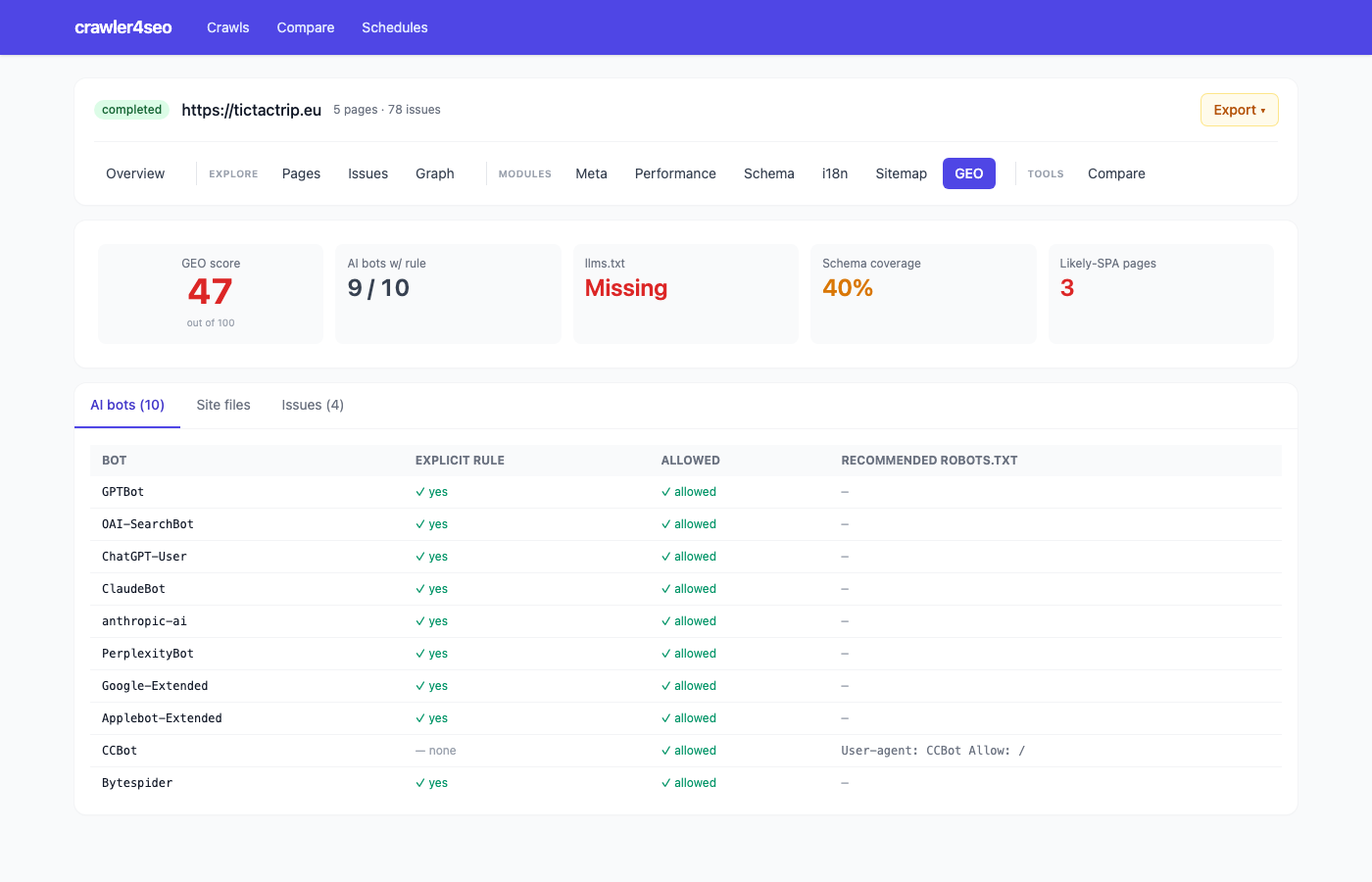
Per-bot allow/disallow for 10+ AI crawlers — GPTBot, OAI-SearchBot, ChatGPT-User, ClaudeBot, anthropic-ai, PerplexityBot, Google-Extended, Applebot-Extended, CCBot, Bytespider. One accidental Disallow kills your visibility.
llms.txt presence & format
The audit fetches /llms.txt and /llms-full.txt at your root. If missing, it suggests a copy-pasteable template. If present, it validates the markdown structure AI agents expect.
JSON-LD / Schema.org coverage
AI engines parse structured data to understand entities, products, articles and FAQs. The GEO audit scores the percentage of your pages that carry JSON-LD and flags gaps.
JS-dependency risk (SPA detection)
AI crawlers don't execute JavaScript. Pages where the main content only appears after JS rendering are invisible to them. The audit flags SPA-like pages automatically.
Content density & citation-friendliness
LLMs cite concise, fact-dense content. The audit surfaces thin pages, pages with buried answers, and pages whose titles don't match their content — the three things that kill citation odds.
GEO score (0–100)
A single number weighted across bot coverage, llms.txt, schema density, content signal and rendering safety. Track it across crawls to see GEO progress like you track SEO.
How to rank in ChatGPT, Claude and Perplexity
Seven fixable signals that decide whether AI engines cite your pages. Run the audit to see which ones your site is failing.
- 1
Allow the right AI bots in robots.txt
Most sites inherit a default robots.txt that blocks unknown user-agents. Explicitly Allow GPTBot, ClaudeBot, PerplexityBot and Google-Extended if you want citations.
- 2
Publish /llms.txt at your site root
A markdown index that tells agents what your site does, which pages matter, and how to cite them. Growing support across ChatGPT, Claude and Perplexity crawlers.
- 3
Add JSON-LD to every page that could be cited
Article, Product, FAQ, HowTo, Organization — whichever fits. AI engines parse these to resolve entities and decide which pages are authoritative for a topic.
- 4
Do not hide key content behind JavaScript
Server-render or prerender your main content. If ClaudeBot fetches a URL and sees an empty shell + a bundle reference, you will not be cited. Use plain HTML or SSR.
- 5
Lead with the answer, not the intro
LLMs cite snippets, not essays. Put the fact-dense answer in the first 2 sentences, then expand. Pages structured around a clear question rank and cite far better.
- 6
Keep titles, H1 and opening paragraph aligned
Ambiguous titles lose to unambiguous ones. If your title says one thing and the body discusses another, AI models down-weight the page when answering the prompt.
- 7
Monitor AI-bot hits in your access logs
Once allowed, track GPTBot / ClaudeBot / PerplexityBot crawl rate over time. Zero hits = a robots.txt, firewall or CDN rule silently blocks them.
GEO audit vs AI SEO audit vs traditional SEO audit
The three terms overlap but audit different surfaces. Here is what each covers.
| Traditional SEO audit | AI SEO audit | GEO audit | |
|---|---|---|---|
| Who it audits for | Google & Bing | Google + AI engines | ChatGPT, Claude, Perplexity, Gemini, CCBot |
| AI-bot robots.txt | — | Sometimes | Full per-bot matrix |
| llms.txt check | — | Rarely | Yes, with template |
| Schema.org coverage | Rich-results eligibility | Coverage % | Coverage % + gap report |
| JS-rendering risk | Render budget | — | SPA detection |
| Composite score | SEO score | — | GEO score 0–100 |
llms.txt checker & template
llms.txt is the emerging standard for telling AI agents what your site does and which pages matter. The GEO audit fetches it from your site root, validates the structure, and outputs a ready-to-deploy template if you haven't published one yet.
Save it as llms.txt at your site root, deploy, and re-run the audit to confirm.
Frequently asked questions
Things people ask before switching.
What is a GEO audit?+
A Generative Engine Optimization (GEO) audit scores a site on the signals AI engines use to discover, understand, and cite its pages. That includes AI-crawler access (robots.txt rules for GPTBot, ClaudeBot, PerplexityBot and others), an llms.txt file, JSON-LD schema coverage, rendering safety (no JS-only content), and content citation-friendliness. It is the AI-era equivalent of a technical SEO audit.
How is a GEO audit different from an AI SEO audit?+
"AI SEO audit" is the broader term people search for — it typically means a traditional SEO audit plus some AI-specific checks. "GEO audit" is the narrower, more specific workflow: it focuses only on signals relevant to generative engines (ChatGPT, Claude, Perplexity, Gemini). crawler4seo runs a full GEO audit inside its regular crawl, so you get both views in one run.
Can I use this as an llms.txt checker?+
Yes. The GEO audit fetches /llms.txt and /llms-full.txt from your site root, validates the markdown structure, and flags common issues. If the file is missing, the audit outputs a ready-to-deploy template based on your crawled pages — so you can paste it straight into your repo.
Does the audit actually help me rank in ChatGPT or Claude?+
Ranking in AI engines is not a single lever, but the checklist on this page covers the signals that demonstrably move the needle today: bot access, structured data, rendering safety, content density. The GEO audit tells you exactly which of those you are failing, so you can fix the specific blockers instead of guessing.
Is the GEO audit really free?+
Yes — crawler4seo is a free desktop app during early access, with no URL limit and no account required. The GEO audit runs automatically as part of every crawl. Your data never leaves your machine.
Which AI crawlers does it check?+
GPTBot (OpenAI), OAI-SearchBot, ChatGPT-User, ClaudeBot (Anthropic), anthropic-ai, PerplexityBot, Google-Extended (Gemini training), Applebot-Extended, CCBot (Common Crawl, used by many LLMs) and Bytespider. The list tracks the official user-agent strings each company publishes.
Run your GEO audit in one crawl
Download the free desktop app, paste a URL, hit Start Crawl. The GEO audit runs automatically alongside the full SEO audit — no extra steps, no cloud, no account.
Download free